


The Two Rings - Pius IX and St Dr Alphonsus...
The Two Rings
Blessed Pope Pius IX, Saint Alphonsus, and the connection with Naples...
In the autumn of 1849, Pius IX was not only the head of the Church: he was an exiled pontiff.
In the autumn of 1849, Pius IX had become the Pope not only because of his birth in Senigallia, but also because of his hospitality, his familiarity with the Bourbon court, and his devotion to the saints of that land.
Among these saints, Alfonso Maria de Liguori, the most holy of the Neapolitans and the most Neapolitan of the saints, held a special place.
The connection began even before Mastai Ferretti became Pope. In the council of May 8, 1839, when he was bishop of Imola, he had convincingly supported the canonization of Alfonso, addressing Gregory XVI because he would not differ further from that honor. All, and especially the bishops, said in substance that they could find in Alfonso a shepherd to "admire, imitate, and venerate." The canonization was celebrated on May 26 of the same year. The historical study of Giuseppe Orlandi documented this.
Ten years later, Mastai Ferretti, who had become Pius IX, finally had the opportunity to kneel before the remains of the saint he had publicly defended.
It was October 8, 1849.
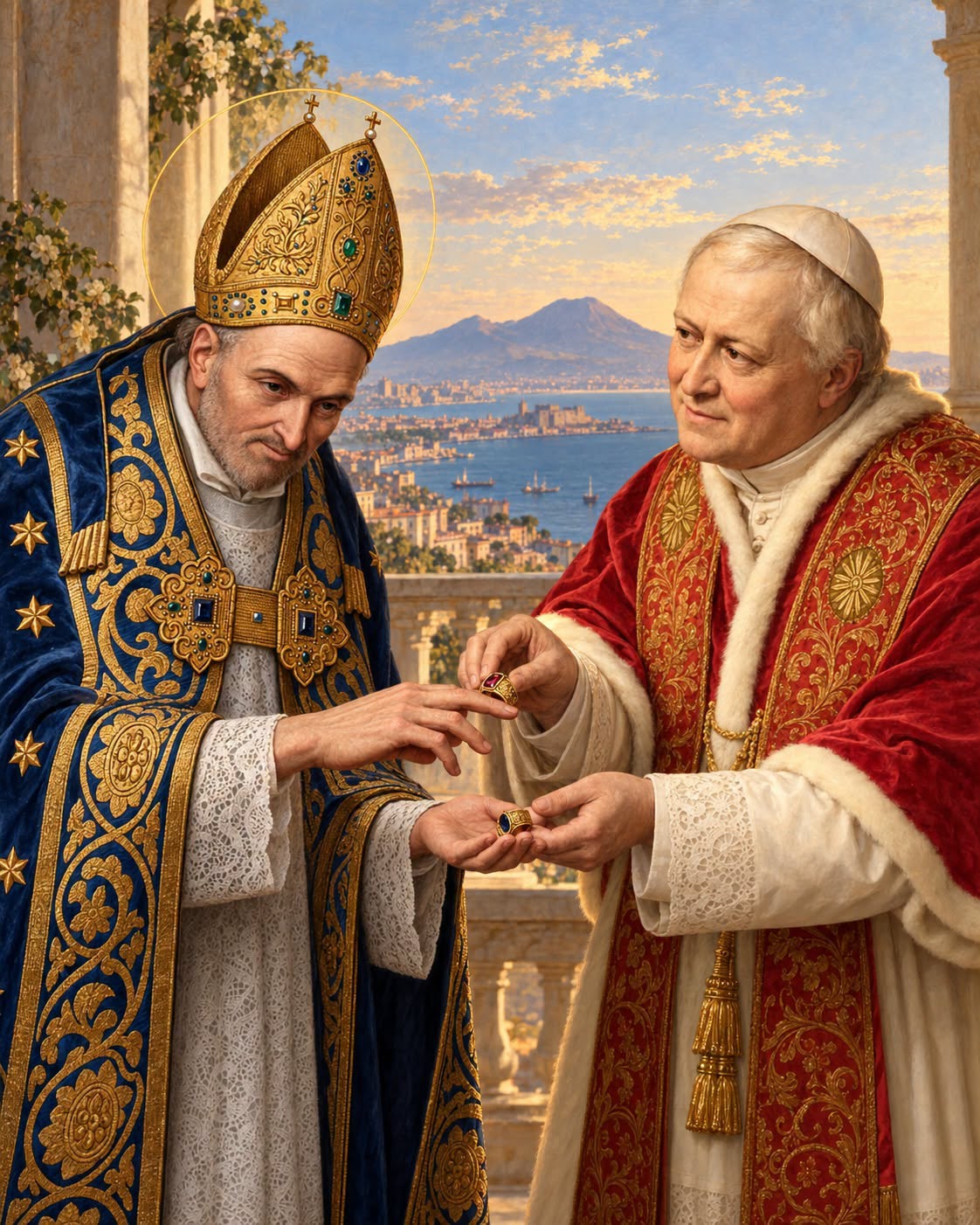
The Pope left the royal residence of Portici for Pagani. He was accompanied by Ferdinando II, the count of Trapani, Cardinal Giacomo Antonelli, and other members of the papal court and entourage. It was not a protocol visit, but a pilgrimage personally desired by the Pope.
In the church then dedicated to Saint Michael, today Basilica of Sant'Alfonso, Pio IX celebrated Mass at the altar where the relics of the great Neapolitan bishop and missionary were kept.
After the celebration, the gesture that remained in the memory of the Redentorists and the city of Pagani occurred.
Pio IX knelt before the urn. He removed the glass that protected it and approached the statue that guarded and presented the relics of the Saint to veneration. Thus, he removed his precious pastoral ring and placed it at the finger of Saint Alfonso. In his place, he took the ring that was on the Saint's hand.
The Redentorists remember him with simple and solemn words: the Pope "exchanged his magnificent pastoral ring for the one the Saint wore on his finger." The episode is passed down from the biography of Father Augustin Berthe and is confirmed by the subsequent historical research on the Alfonso tradition. The Memorial of the Redentorists of October 8 still preserves the story.
The ring of a bishop is not just an ornament. It represents the bond of the shepherd with the Church entrusted to his care; it recalls authority, dignity, faithfulness, and dedication. By handing over his ring to Saint Alfonso and taking the Saint's, Pio IX seemed to publicly acknowledge the greatness of his pastoral magisterium.
It was as if the Pope were saying to Alfonso: "Your way of leading souls is also mine."
Saint Alfonso had fought both the laxism and a cold, rigorous morality, unable to consider the concrete weakness of people. He indicated the path of prudence, mercy, and pastoral benevolence. Historian Giuseppe Orlandi saw in the exchange of rings almost the symbolic consecration of this teaching: the Pope's magisterium recognized in the bishop's magisterium a safe way for the Church.
The gesture of Pagani did not remain isolated.
Pius IX continued to show benevolence towards the spiritual children of Saint Alphonsus. In 1865, he entrusted the ancient icon of the Mother of Perpetual Help to the Redemptorists, which was again displayed for veneration in the Roman church of Sant'Alfonso in Esquino on April 26, 1866. The Congregation was entrusted with the mission of making known this devotion in the world. The history of the entrustment is preserved by the same Congregation.
The coronation came in 1871. With Pius IX, Saint Alphonsus was proclaimed Doctor of the Church. The Pope thus officially recognized the lasting value of his moral and spiritual doctrine: that "safe path" between rigidity and laxity, which still characterizes the Alphonsian teaching. The Holy See recalled this decision on the centenary of the Doctorate.
Even the relationship with the Bourbon family surpassed the circumstances of 1849. When, after the fall of the Kingdom of Sicily, Francis II and Maria Sofia had to leave Gaeta, Pius IX welcomed them to Rome. The son of Ferdinand II found in the Pope the same hospitality that his father had offered to the Exiled Pontiff: first at the Quirinale and then, permanently, at Palazzo Farnese. The reciprocity of the reception is attested also by the biography of Francis II published by Treccani.
The column erected in Sant'Alfonso Square in Pagani continues to remember the visit of October 8, 1849. But the most eloquent monument remains the gesture made in front of the urn: two rings exchanged in the silence of a church.
The Pope's ring remained with Saint Alphonsus. That of Saint Alphonsus passed to the Pope.
It was like a pact: the Saint would accompany the Pontiff in the trials of his long pontificate; Pius IX would guard and elevate the spiritual heritage of the Saint and his Redemptorist children.
A material exchange lasting only a few moments, became a spiritual bond entrusted to history.


