


Pope's Spokesman and CSsR...
EXCLUSIVE: THE HOLY FATHER’S SPOKESMAN SPEAKS WITH US
A year of Pope Francis: the Holy Father’s spokesman speaks exclusively to us On the first anniversary of Pope Francis’ pontificate, the Redemptorist missionaries, Frs. Rafael and Biju of the Congregation’s Communications Office went for an exclusive interview with the spokesman of the Holy Father. Father Federico Lombardi received the missionaries in the interview room […]
A year of Pope Francis: the Holy Father’s spokesman speaks exclusively to us
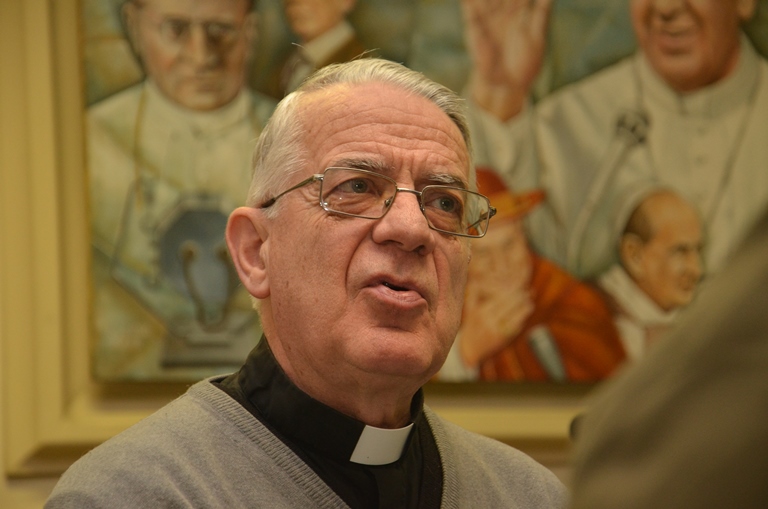
On the first anniversary of Pope Francis’ pontificate, the Redemptorist missionaries, Frs. Rafael and Biju of the Congregation’s Communications Office went for an exclusive interview with the spokesman of the Holy Father. Father Federico Lombardi received the missionaries in the interview room of Vatican Radio and spent almost two hours with them. Friendly and welcoming, he spoke of the importance of the work of communication and noted that offering news in different languages was a “sign of respect” for people, countries and cultures. Here are some parts of the interview.
Surely your work must include regular meetings with the Holy Father. What is it like to work closely with Pope Francis?
In my work there are several ways to accompany the activities of the Holy Father. I can be informed and understand what the Pope is doing without needing to go very often and personally disturb him because I see and know what he is doing through my different sources of information among his co-workers, the people closest to him. Naturally, there are also some occasions when I see him in person and can ask him for some information or, let’s say, more specific directions. In general, though, as we all know, Pope Francis is an extremely communicative person, extremely open and available, who possesses a way of engaging people, let’s say, and a very easy and quick communication with his co-workers, including new forms not likely to have been used in the past. We know that he uses the telephone both personally, let’s say, and more frequently than his predecessors. At times, he calls to speak briefly of something that is of some urgency, even if the information perhaps has varying degrees of importance. However, if you get a simple and specific question to him, he will bother to get the answer, sometimes through one of his co-workers or sometimes by calling back personally. So, he has a style very, shall we say, free, flexible and quick to respond to the questions that are put to him.
What is the normal routine of the Holy Father?
In very simple terms, shall we say, I believe the Pope gets up early in the morning and spends the first part of his day in prayer, personal prayer and silence. And then, at 7 a.m., he celebrates Mass in the chapel of Santa Marta, where he lives. Around forty people usually participate in the Mass, in which he gives a very simple and direct homily that touches the hearts of those present. It is an improvised homily, shall we say, without a written text but the fruit of his meditation on the readings of the Mass of the day. After Mass, at the exit, that is, where the people are leaving the chapel, he greets almost everyone present one by one. Therefore, there is also, shall we say, personal contact with the people who have prayed with him that morning. Then, he has breakfast, a time for information, let us say, for reading the newspapers and the press releases that inform him so much about reality. Then the morning audiences begin, which normally are held in the Apostolic Palace, that is, the place where the popes, also his predecessors, would receive people in the so-called private library or in the Sala Clementina, if there are any groups. Pope Francis has moved up the time for beginning these audiences by about half an hour. In the morning, the meetings with individuals and with groups begin at 10:30 and go until about one o’clock in the afternoon. So this is a half hour more than in the schedule of the previous popes who normally began the audiences at 11:00. There are audiences, at times, with individual people, and sometimes with groups and thus the Pope does his work of personal contact, of meetings with people. When there are groups, there is also a discourse. On Wednesdays, of course, there is the general audience, which is very challenging because the Pope comes out already at 10:00 with the Jeep popemobile, in the square to greet various people and then, say, about 10:30, he begins the colloquium, the catechesis from the parvis of the Basilica. After the catechesis and the greeting in different languages, he comes down and greets first the sick who are in wheelchairs in certain areas of the square. He then returns to the parvis and greets the other people who have been organized for the “kissing of the hand,” the personal greeting with the Pope by those in the first row. All this often lasts beyond 12 noon, so there are at least 2½, sometimes 3, hours that the Pope is in the square greeting, meeting, hugging and also giving catechesis to the people. This is Wednesday morning, which is something very special. On the other days, as I said, there are audiences with individuals or groups in the morning.
And in the afternoon?
After lunch, in the afternoon, the Pope again has many meetings with individuals, sometimes less official in nature. These meetings are with people he knows or who have asked to speak with him and whose names are not published, like in the morning audiences, but are nonetheless important. He often meets with his closest co-workers, such as the Secretary of State, the deputy Secretary of State or other heads of departments whom he often meets in the afternoon and evening. So even the afternoons and evenings are work periods, let’s say, for talking and important meetings. At 7:00 p.m., the Pope normally goes to the chapel for personal prayer. The afternoon thus usually ends with a prolonged period of personal prayer in silence, in the Santa Marta chapel. Then there is dinner and afterwards, I believe, for at this point I no longer watch the activities of the Pope, but we know that he also writes personal letters that are not official, but are written by hand to people who have written to him and to whom he wants to respond. Sometimes, he also makes phone calls that are not official, that are, shall we say, of a personal nature, often with people who suffer, who have presented to him some particularly painful case to which he wants to be present with a letter or with a phone call. One thing we know is characteristic. If he wants to respond as Pope to the difficult situations of the poor, the sick or people with great difficulties, he appoints an almoner [an official distributor of alms]. The function of an almoner already existed. However, Pope Francis makes an innovative and intense use of him and, therefore, entrusts to him many of the requests he receives through letters or through other forms saying “there you handle it well, in my name, trying to bring real help to these cases.” So here’s the figure and activity of the almoner that already existed and has become with Pope Francis a figure, so to speak, more active and for him also more personally useful to respond to the many requests he receives.

I suggest a situation: a simple person of the people comes to you and asks what is the Pope like in person? How would you respond?
I do not have much to add to what we have already seen, particularly during the general audiences and some of the images that have not been transmitted. The Pope has a very direct relationship with people, very friendly and smiling, very welcoming. People feel close to the Pope. There is no distance, no difficulty in entering into a relationship with him who speaks with great naturalness and simplicity. And this is what he does when he greets all the people who participate, for example, in the morning Mass or when he greets people in the general audience along, shall we say, the barriers or when he greets all the sick that he is going to visit on the occasion of the audiences in which groups of sick people come to him, then, he is a person who is extremely, shall we say, direct, simple, warm, friendly, not difficult or complicated who makes one feel completely at ease. I do not have anything extraordinary or different to say about what everyone sees in him and that has, in fact, aroused so much attraction to him.
(Translation: Fr. Joseph Dorcey, CSsR from our Roman Site)


