


Redemptorist confreres the midst of persecution in Madrid...1936
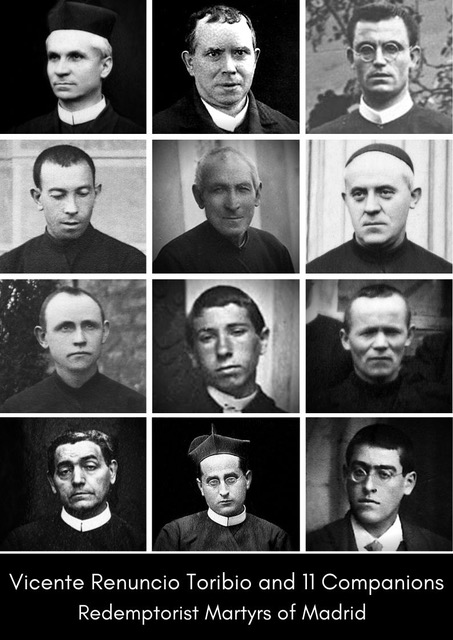

On July 19, 1936, the bombing of the Mountain Barracks began; at 3 1⁄2 in the morning, considering the situation very serious, I dressed quickly and with the greatest stealth I climbed the tower from where I could observe the evolution of the airplanes and the smoke produced by the destructive bombs.
From that moment on, we were already in the middle of a revolution for me. In fact, after 3 days, after taking the measures that the superiors deemed appropriate regarding the people and things in the house, we left the convent. I said the last mass, which I ended between sobs and tears just like the attendees. As there was a ciborium full of sacred forms and I could not consume them all, since they were more than 500, I warned them of the danger in which we were of being desecrated the Ssmo. St. and I exhorted them to behave like martyrs in persecutions; I gave the sacred communion that for the last time would be distributed in our Sanctuary of P.S. They would draw strength to withstand all the tests no matter how difficult they were. When saying "the sacred communion that would last be distributed..." they burst into sobs and weeping so loud that they moved me; and without being able to remedy it I had to continue in tears, exorting them to conformity with the will of God and constancy in prayer to our mother of the P.S. After the Mass, I said goodbye to the P.S. saying for the last time to the virgin "My mother, it is yours; keep it and help me and mine. Goodbye."
A fact of utmost importance and great feeling for us took place these days of August 1936, and was the death of D. Linen See Murgia, our friend. A few days before his death I went to his house and confessed to everyone, but soon I received the news of the crime as follows: "The doorman denounced everything he knew, which is in the benefit and glory of the deceased; knowing that he was a priest, that he had had friars in his house... one afternoon he went up to the floor in the company of several militiamen and knocked on the door; but when he asked who he was, he replied: "There will be a little lord, that it is me," and behind him passed several wretches who urged him to follow them, because they had to ask him some questions in Fine Arts, about some complaints received." As Da Trinidad wanted to oppose, he was stopped by saying, "Reassured, Madam, once the interrogation is over we will return him home." What happened; that they found him next to the wall of the cemetery viciously murdered. He was recognized by an uncle of his, whose nephew was with me in prison, who told me these and other details.
Another more comforting event than the previous one took place on September 8, for me with a pleasant memory. I will never forget it! On the 7th in the afternoon (at dusk) I am called by the Superior of the Sacred Hearts of Fuencarral who lived on the adjoining floor and tells me very slowly and in silence... "I have been brought several consecrated forms to receive communion tomorrow... do you want V. one?" "Yes, mother, I told you, God will reward you such a beautiful action and I will always be grateful to you!" Within a few minutes I already owned such a coveted treasure. Oh, my goodness! Impossible to discover the joy that flooded my soul, being able to squeeze Jesus in the Blessed Sacrament against my heart! I took him to my room; I placed him in a glass and on my knees in his presence I let off steam to my liking. With what fervor is it asked for at those moments considering on the one hand the imminent death that awaited me and on the other hand the infinite love of Jesus who wants to be my companion, my viaticum on the journey that I will soon make to his Kingdom...!
Eager to do good to the girls who served me, I told them if they would not have the pleasure of communicating with me, taking advantage of this occasion that perhaps we would no longer have another similar one in this world. They replied that they would gladly receive communion, but since they had not confessed for some time because the Churches were closed, they would not do well. "Do not hurry," I told them, "I will confess you and you will see how happy you are having Jesus in your hearts." In fact, we prepared everything we needed for the case as best we could; and at one at night, when everything was silent, while one watched before the SSmo. the other confessed.
After completing the confessions, we retire to a more interior room. There the three alone with Jesus in the Blessed Sacrament and in the middle of a sepulchral silence I began the preparation for Holy Communion. I reminded them of the communion of the martyrs in the catacombs; the joy we had to receive Jesus, favor that almost all of those persecuted did not have; all in a low voice; and doing the preparatory acts well, I divided the Sacred Form and the three of us received communion. What moments, my God, so solemn, increased by the silence of the night! While men slept, Jesus watched with us! I gave thanks, and after exhorting them to trust in Jesus who does not abandon us at such critical moments and our Mother of the P.S., I ordered them to go to rest peacefully. Jesus and Mary are with us, we have nothing to fear.
Meanwhile, I, with a bird's eye watching what they did with our Church and convent. 4 or 5 days later I was told that the FAI was seized from P. Barrón and that they would put their offices in it, so I had to leave my hiding place and look for another one. Where to find it? I wrote several letters but... no one dared to carry such a compromising hindrance. I understand that they were right, but how do you get out of trouble? Again I went to prayer and again Jesus and Mary came to my aid. A child confessed to me and I went to him, without even suspecting the result of my lawsuit. Indeed, as soon as they received my letter, they came to look for me. I told them to wait even the next day, but nothing; they insisted that I had to get out of there that same afternoon and ... God's judgments! I spent a relatively quiet month in my new residence. After lunch I talked for three quarters of an hour about spiritual things with great happiness from everyone and at night we prayed in common the Holy Rosary and other devotions; in addition, in particular I did my exercises as best I could. That's how time went by... when the night of Santa Teresa (at about 2 1⁄2) the bell rang and there was no choice but to open the door to several police officers and militiamen. Why did they arrest us? Well, simply because I didn't belong to the CNT; I was also suspicious because they demanded certain papers that they knew very well I couldn't have. Anyway, they took us to the Czech Republic the son of the Lord and this poor religious, then a music teacher. Already in that den of outlaws and after taking all the statements they wanted, they put us in a basement. On the third day we were taken to court. When it was my turn, I passed by and said to me at first, "Look, say what you want, I won't believe you." "Well, you could save the questions," I replied, "but I promise to tell you the truth even if you don't believe me." "But if you want, everyone's same questions and the same answers..." "Well, go to jail until you show that you are affectionate to the regime," and that same night to the Model Prison.
We arrived at 5 in the afternoon and after endless interrogations we were appointed a dungeon at about 11 (without dinner of course) where sitting on an iron and with my head resting on the wall I spent not only that but many nights, surrendered with fatigue and sleep and not being able to rest for a minute. Thank God I suffered everything with great patience and even joy, considering that it was God our Lord who used the reds to purify me from my many sins. It is not to describe what was heard and said in prison; we will put on a veil, I say wrong; we will make a deep pit and bury those same in it so that their stench does not poison us and we die of disgust. There food was reduced to a saucepan of chickpeas with rice and a piece of bacon; at night lentils and to excuse.
During the day we went down to the yard by some iron stairs that we flew more than once. The unclean dungeon, in every way and enough; (6 feet wide and 16 feet long, and there we were 6, 8 and up to 10 men). From there we witnessed the aerial combat. From there we saw the mostruos fight for the park of the West; from there we heard the discharges that the reds made on the poor prisoners every time ours beat them on one of the fronts; because to take revenge for their defeats they went to jail and took out 300, 500 or 600, those they wanted and then viciously murdered them. This is what happened with my countryman Fr. Zarco and other acquaintances. How could we sleep in the midst of so many shocks and crimes? How can we rest always having, day and night, present the militiaman with the gun in his hand, willing to kill us with the slightest slip?
Finally, ours arrived in sight of Madrid and as everyone knows the very hard fighting that took place at the gates of the capital I do not stop to refer to them; I only tell you that in prison they were all these days of great confusion; bombs fell everywhere, one fell in front of me that thank God did nothing to me, although it killed several of my fellow misfortunes. They put us in the basements and even there the grenades followed us; panic spreads everywhere; the sentries throw away the rifle; the responsible corporal calls the reds to pick up the dead and wounded but no one obeys him; then a responsible corporal, taking charge of the circumstances, cries out... "Here we will have no choice but to shout 'Long live Spain' and 'every man for himself.'" Textual! How would the scrubb be? Seeing the directors that we could not live there (because word had spread that the carabineros would go to take possession of the prison, which is why ours bombed so intensely) they decided to take us out; but confusion was of such magnitude that not even in the Tower of Babel was there anything like this. Finally at 11 p.m., after endless contradictory orders they distributed to us and I was lucky in the prison of S. Anton; where again I met Fr. Ibarrola. I say again, because already in the Model the three of us met: Tellería, Ibarrola and this servant; there we confessed in the courtyards as God made us understand and here we made our own; but Fr. Tellería had left before and I knew nothing about him until much later.
In prison S. Anton, we lead a life similar to the previous one. There I met many acquaintances. Finally in the novena of the Immaculate (which by the way we did together Fr. Ibarrola and a servant) several courts were formed to try all prisoners. This time I had a very correct man by chance; the questions however like the previous ones, but seeing that not having a C.N.T. card did not constitute a crime, just as the other accusations did not ask me very sharply and promptly: "Is it V. Catholic?" To which I replied with a "Yes, Lord; and if because I am a Catholic I deserve two shots, they can already shoot me, because I will not apostatize these ideas..." Seeing my integrity, he said: "No, sir. If we don't kill anyone because we are Catholic... well, V. can retire." A few days later I left S. Anton and I returned to the house where I had been taken prisoner; but if they could live there and not find an even moderately safe place, they waited to take the steps to get the entrance into a Legation. Again we went to fervent prayer and once again we were heard by Jesus and Mary. It would seem that God our Lord had visibly set out to prove to me the effectiveness of prayer on so many occasions how many times I had come to Him, and this despite my many infidelities in his holy service, in regular observance. Blessed and praise be the Most Holy name of Jesus and Mary, who works so many wonders on behalf of those who pronounce it with faith, trust and love!
Endless difficulties put those who intended to enter a Legation or Embassy. And so much so, that despite so many steps taken to achieve it, it seemed that all the doors were closed to us; especially not having the money with which many had achieved their attempt. Thus, one day we stumbled upon the person in charge of the Guatemalan Embassy, a man who had obtained many thousands of money for the good (or bad) skill that had been given in solving the many businesses that came into his hands. Well, when he told him that he was a religious without influences and persecuted by the Reds, God our Lord touched his heart, and in two or three visits the difficulties were smoothed up and this his servant was admitted to the Guatemalan Legation (today annex of Chile, for reasons you already know). There my life, although apparently more freely, than in prison, was no less exposed by the continuous campaign against us that all newspapers made daily. Hence the assaults on the Legations; hence the deprivation of food, letters, visits ...
With life always hanging by a thread and trust placed in God (this always) I lived a year in the Legation. More and more threatened and less food every day, until we get to give us for food a handful of carob trees cooked with water alone and with more soil and songs than seed, and at night a small onion also cooked with water alone. When the Ambassadors saw that life was impossible in this way, they began to talk to the Government of Valencia - Barcelona successively; and after several months of discussions, ... they managed to evacuate the gentlemen over 45 years of age who were not military.
It was an absolutely necessary condition that each man put his true profession; that is why after my name and two surnames I added, Redemptorist religious profession; I resided in Manuel Silvela 12, Madrid. With a bundle of documents from all the red authorities, Ambassadors... I left Madrid on January 1, 1938; I made the trip all by land, with the following itinerary... Madrid – Valencia – Barcelona – Porlian – Cervera (already France) – Carbona – Toulouse – Torbes – Po – Bayonne – S. Juan de Luz - Fuenterrabía. This is not to mention the intermediate populations such as Tortosa, Tarragona, Girona... But where we keep memories worth mentioning is from France; because in all the towns we were received with singular signs of aversion; especially in Cervera and S. Juan de Luz. All his desire (of the communists) was to make trouble so that we could go back to the red zone and shoot us. They showed it by signs.
We finally took the car and to the border. Even there they didn't want to let us through. A policeman of ours came and one by one, walking, we crossed the international bridge. What a difference in treatment! What a show of affection from everyone to everyone! Greetings... accompanied by sandwiches, coffee with milk...; "Long live Christ the King, whether they want it or not, he must reign in Spain!" ... We arrived in Fuenterrabía and after fulfilling our duties as evacuees before the authorities, I went to Pamplona, where already among mine I began the rest of soul and body that I was so in need of. Blessed be God and Blessed be the Mother of Fr. Help, I was abandoned for a single moment in this year and a half of such a random life!
Support me, my God, and don't abandon me! I told her when I had to leave our Church and Convent of Madrid, and how well Our Lady has fulfilled this request with me that I addressed to her with all the truth of my soul. May this kind Mother grant me the perseverance of a true Redemptorist to sing in heaven the mercies he has used with me.
Ladislao Díaz. C.SS.R.
Ladislao Díaz. C.SS.R.
(Ladislao Díaz Huélamo, C.Ss.R.) Memories of the months spent in Madrid during the religious persecution of 1936-1937. January - February 1938: Original in APRM., XIX, 1b. 34 pp.)
ANOTHER WITNESS OF THE MODEL PRISON BAGS

The Redemptorist P. Raimundo Tellería, miraculously a survivor of the sacks of the Model Prison in Madrid, tells us about his experience those days:
"Therefore, there were four of us left in the cell when the tragic days - November 7, 8 and 9 - came. We knew nothing about the advance of Franco's troops, who were supposed by the bulists in Getafe since the end of October, nor about the flight of the Government of Madrid. But a shiver of astonishment, terror, despair shook the souls and nerves of the poor prisoners when between two and three in the morning of those days the locks were unfolded with a funeral and from the back of the gallery the echoes of the names indicated for the sacrifice rose. It was the first blow to the back of the poor victim's neck. Immediately, a few hugs in the darkness of the cell, restrained tears, goodbye to heaven ..., and loaded with his blanket the unfortunate moved away, entrusting his belongings and his last feelings to his companions so that on freedom day, they would send them to his own, and his were the mother, the wife, the children ... In the bright light of the light bulbs in the background of the gallery, the Asian silhouettes of the militiamen like those of the demons of Dantesque hell were cut out."Silence turned to the cells, more difficult to sleep to the eyelids. Those days we were veneered, that is, closed without going down to the yard. The conversations, the reading of entertaining books, the tunes ("Alas, alas ... cieliño...") that other days came to us from the cell across the street, the visits of the friendly ordinances (prisoners too), the epistolary correspondence ... everything was invaded by that gust of hatred and blood unleashed against the prison. Oh! It was easier to load prisoner trucks, tying them to each other, and get rid of them in the fields of Torrejón de Ardoz, Barajas, Paracuellos del Jarama, than to face the victorious troops of Yagüe. How many were chosen for these criminal sacks? Difficult to say, because those selected from all the galleries and because they took care, in many cases, to replace them with new prisoners brought from the street."So when after three days, having the walls of the cell embedded in the brain, we went down again to the courtyards we saw older faces, cut short optimisms, more accentuated paleness, flares of helpless anger in the looks and words. Among the disappeared was a septuagenarian general, to whom through an elderly priest I had lent some scissors, which were a treasure for prison and who was carried with them in his purse. There was also a lack of a young doctor, Pacho Olavarría, a very nice Bilbao, whom I had well known since the presbytery of Manuel Silvela: he was called alone, almost mid-morning, and could still say goodbye to Fr. Díaz through the hole in the door."We probably escaped the three Redemptorists at that time. When we saw each other again, we were able to
Encourage us to perseverance and prepare our souls to receive the crown that could come when we least expected it. Precisely it must have been those days when Resignation was taken from the adjoining gallery and was on its way to being Machiñena."Some hope later waned, because it was said that some of those prisoner trucks had been taken by some of the nationalists and had even given the names of the liberated by radio.But once again the hoaxes were balls. And in truth, it will turn into bitter disappointment, because hope that his or his were part of those expeditions released by Franco supported more than a few families in Madrid. Among the new prisoners in those days we stumbled upon Fr. Arnáiz [the priest of Madrid Eusebio Arnáiz Álvarez], who had visited us in Madrid shortly before the war. Until then, he had weathered the storm as an attaché and interpreter of an Embassy; but a complaint of an exacolyte of his church had been more effective than all his documentation in perfect order: from his lips we collected authentic news about the state of military operations."(R. Tellería, Madrid in the red. Personal memories during the Civil War in Madrid, T. II, pp. 50-52)

WITNESS OF A MODEL PRISON "SAUGE"

In a cell of the 2nd gallery, José Machiñena, Superior Redemptorist of the Sanctuary of Perpetual Help in Madrid, was somewhat sad, sitting on the floor, wrote on a piece of paper...
Today, November 7, 1936, we went out to the sad and downs and downs courtyards. There has been no desire to play and in the circles the event of the day that occurred throughout the night was commented; some assure that the expeditionary political prisoners have left for Alcalá de Henares; others claim that they have reliable reports that they have been taken to Chinchón for fear that national troops will enter Madrid; a commander, my friend, has approached me and with all kinds of reservations has transmitted to me the version I had heard from a prison officer; namely: that the first car had gone to Alcalá, but that The others have been murdered on the outskirts of Madrid, and that part of them have been buried alive; adding to me: "the day that the whole truth is known it will cause horror and horror... Before taking them out of prison they have been stripped of everything they had in their pockets, money in vouchers, watches, cigarette cases etc... those who wore new shoes, or Americans of some price, have stripped them of them too; they have tied their hands, put them on buses, and so they have taken them to the place of execution.Once there, and placed next to a ditch, which the militia had opened in advance, he ties them up.rum again three by three, or four by four, which, reaped by machine guns, were falling, dragging each other, into the ditch, some dead and others alive...."Of everything that happened tonight I have been an eyewitness; I was arrested and imprisoned in the 5th Gallery and "in mid-October and on the occasion of the raid made by the government of the retired military, whom it caught, after deceiving them villainously, we had to evict the 5th Gallery to make room for the retired from the army. They took us to various Galleries where we were distributed, being lucky enough to go to the 2nd, and to Fr. I resign. It was a very pleasant surprise and a great consolation for both of us to find ourselves after as long as we had been separated, without knowing anything about each other. There were three of us in the cell, the two Fathers and a Galician lawyer, named José Rumbao, a little boy, but a bundle of nerves. He behaved very well with us. Although it was rare the night when we did not hear any shock in the vicinity of the prison, and since it was not exactly a lullaby to sleep deeply, yet one had to get used to so many strange and hard things.... That in spite of all our lives it was going its course with relative tranquility. But, in the first decade of November, things began to take a tragic course.
On November 7, and around 4 in the morning, we heard the roar of the locks and the prison doors that were opening. We realized at the event what it was about: officially, a transfer of prisoners to Alcalá de Henares, to Chinchón, anywhere; in fact ... to Torrejón de Ardoz or somewhere else on the outskirts of Madrid to shoot them the noise of the doors that opened was getting closer and closer to the cell. Now they are going to come here, I was telling me, and who are they going to call but me! The three of us are here, a lawyer, Fr. I resign that appears on the file as a trade clerk, and I who am with all the aggravating factors of priest and religious. In this, the door is opened with a roar, and a militiaman appears before it with a long list of names in his hand. We hold our breath to listen... What name will come out? I have already swallowed the pill and I am in the process of getting up. .. in this you can hear the angry voice of the militiaman who says:
We were dismayed, unable to articulate a word. The Father joins up and tells me:- 'Nicasio Manzanedo (Name)
that had been called Fr. I quit), get up, take your things and go out.
He got up and renewed his religious vows, with an emotion that is easy to guess. I encouraged him to be warned, and if necessary, he would offer God his life for the Church, for the Congregation and for Spain. He got up very excited, telling me to the m arch:"Why do they call me, if I have not given my name or profession, if they have not taken a statement from me or know anything about me? ... What do I do?'"I don't know what to say to him," I replied, "because if he resists, they end up with you. Maybe it's a transfer...'"I offer my life for my confreres in the Province, for the Congregation and for our unfortunate Homeland.'"
(José Machiñena Aríztegui, Memories of Religious Persecution in Madrid in 1936-1937 entitled "Nine Months in the Power of the Reds", April-May 1937 in APRM. XIX, 1b., pp. 9-10.)
We haven't heard about him again.
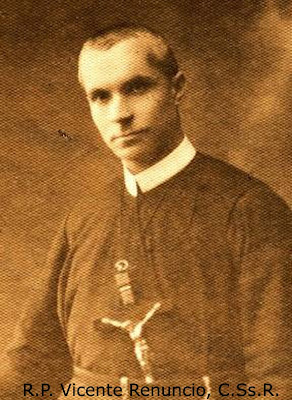

Published by Antonio M. Quesada at 14:45 No comments:
INCIDENT AT THE NATIONAL LIBRARY
José María Ibarrola and his inseparable companion walk along the Recollect promenade, in the direction of the National Library, this sunny morning at the end of September. The library is a space not only cultural, but also a space of freedom, where they can read books of all kinds, and comment on any topic without fear of being surprised by the armed militia groups that swarm in Madrid. Among these, they comment on the dialogue that took place the previous Sunday in the Nunciature with Fr. Alfonso Áriz: the disappearance of five Redemptorists in the vicinity of Perpetual Help: the brothers Nicesio, Gregorio, Aniceto and Pascual and Father Urruchi. They enter the reading room of the National Library and sit next to each other. José María takes a book from Alarcón and while he reads he begins to pray the rosary. Suddenly another man dressed in a monkey stands in front and greets both characters attentively and with great effusiveness; he gets on another Redemptorist, Fr. Raimundo Tellería, and since mid-July they had not seen each other again:

he carried this a book by Azaña, The Garden ofPriests. By hiding the reading, they intersect words
- What do you know about the brothers Nicesio and Gregorio? - Tellería asks.
- Do you remember that they took refuge on Francisco de Rojas Street, on D. Lino Bru Vea Murguía? - Ibarrola Replied.
Yes, of course.
- Well, the goalkeeper demanded that D. Linen that would quickly expel them from their floor. D. Linen, a good priest and fond friend opposed it, but H. Gregory thought that the most prudent thing was to go somewhere else.
- What about D. Did Lino consent?
- He opposed it and told the doorman that they would only come out on his body; and that defense has cost him his life, since on August 15 he was taken and his body appeared on the 16th in the morgue.
- And then, what did the brothers do?
- Well, they went to a pension, but since they didn't have documentation, they didn't accept them. And they went to hide in the warehouse of the Perpetual Socorro publishing house on General Arrando Street. They were almost uneaten there. María Ruiz, the maiden of the Varoness of Rada, was bringing them food; and seeing that H. Nicesio was sick and was welcomed by the Quintanilla family, at 17 Covarrubias Street. It seems that the doorman of the house betrayed them and on August 14 they were taken to a Czech installed in the Valdeiglesias Palace, on Nicasio Gallego Street No. 19. From the inquiries we have made between the circles of relations of the members of that cheka, it seems that they were killed on the road to Valencia, in the vicinity of Vallecas in the early morning of August 16. That on the picket were a certain Juan José Casas, José Mere, Manuel González Perlado, José Ferigal who was the one who drove the car; and José Cuenca. That the latter told María Escolar, who also lives on Covarrubi Street so that "he got into the car, where, in addition to those mentioned, two more men were; that with two or three kilometers left to reach Vallecas, the driver Ferigal complained a breakdown; that they brought down the two detainees, who turned out to be priests; and that when they were on the ground they shot at them, killing them; that they fired: José Army archive. Exp. Summarísimos 5473 (file 4162, Symbol 4790, pp. 7 and 24) and 6225 (file 3111, Symbol 3711, p. 4) for the courage of the two elders; H. Gregory said to the militiamen: "You take us like the Jews to Christ" and H. Nicesio, before being shot, hugged the head of the platoon and sweetly reprimanded him: "Don't you feel sorry to kill an old man who can be your father and even your grandfather?" and then he asked them to let him pray a prayer and then they could shoot him.

It would be like 11 in the morning and still talking Ibarrola, whether the door of the reading room opened wide and "unshiftly a dozen militiamen rush into the room, with some machine guns, with rifles or simple pistols others. ... it was a fascist meeting! ... They proceeded to the individual search, [the] locked them in another room of the Library, called all the employees of the Library present or absent with whom, according to them, the alleged fascists were in relationship, [the] divided them into three or four groups taking into account the diversity of identity documents... ... Ibarrola had been classified ... in the most general group, that of those who did not have documents from the Popular Front; [Tellería] was placed between three or four railway workers, who should be like Turkish [Tellería]. At the end of all that uproar, vans and cars had been arriving at the garden of the Library to transfer the fish from that raid to the Directorate of Security" (Tellería, Madrid al rojo. Personal memories during the Civil War in Madrid, T. II, pp. 9-10).
* * *
In the General Directorate of Serurity, located at the Puerta del Sol, in the Post Office, there are two files of 2 unidentified corpses collected at the City Council of Vallecas that say:
"An unidentified man of about sixty-five years old, height 1,800, strong complexion, somewhat bald white hair, wearing a striped black suit, striped white shirt, blue suspenders, leather belt, white and long underpants, black stockings with the S mark. a cross and R black slippers and brown cap died at kilometer seven yesterday at five o'clock coming soon as a result of a fracture of the base of the skull according to an optional report and his body will have to be buried in the Cemetery of this town. A letter addressed to Gregorio Zugasti domiciled in Manuel Silvela fourteen Madrid" (Civil Registry of Madrid, Section 3a, Volume 57-31, folio 263 vto., No. 139).
"An unidentified man of about eighty years old, height 1,800, white hair, quite bald, wearing black plaid pants, a caki-colored dril jacket, white plaid shirt, long white underpants with the initials "N.T." and a cross, black stockings and black one-piece boots with elastic and black cap with drawings died at kilometer seven of the Road yesterday at five o'clock next as a result of a fracture of the base of the skull as a result of an optional report and his body will have to be buried in the Cemetery of this town. In addition, a rosary and a medal were found" (Civil Registry of Madrid, Section 3a, Volume 57-31, folio 264, No. 140).


