


Rev Fr Louis de Buggenoms CSsR... died 1882...
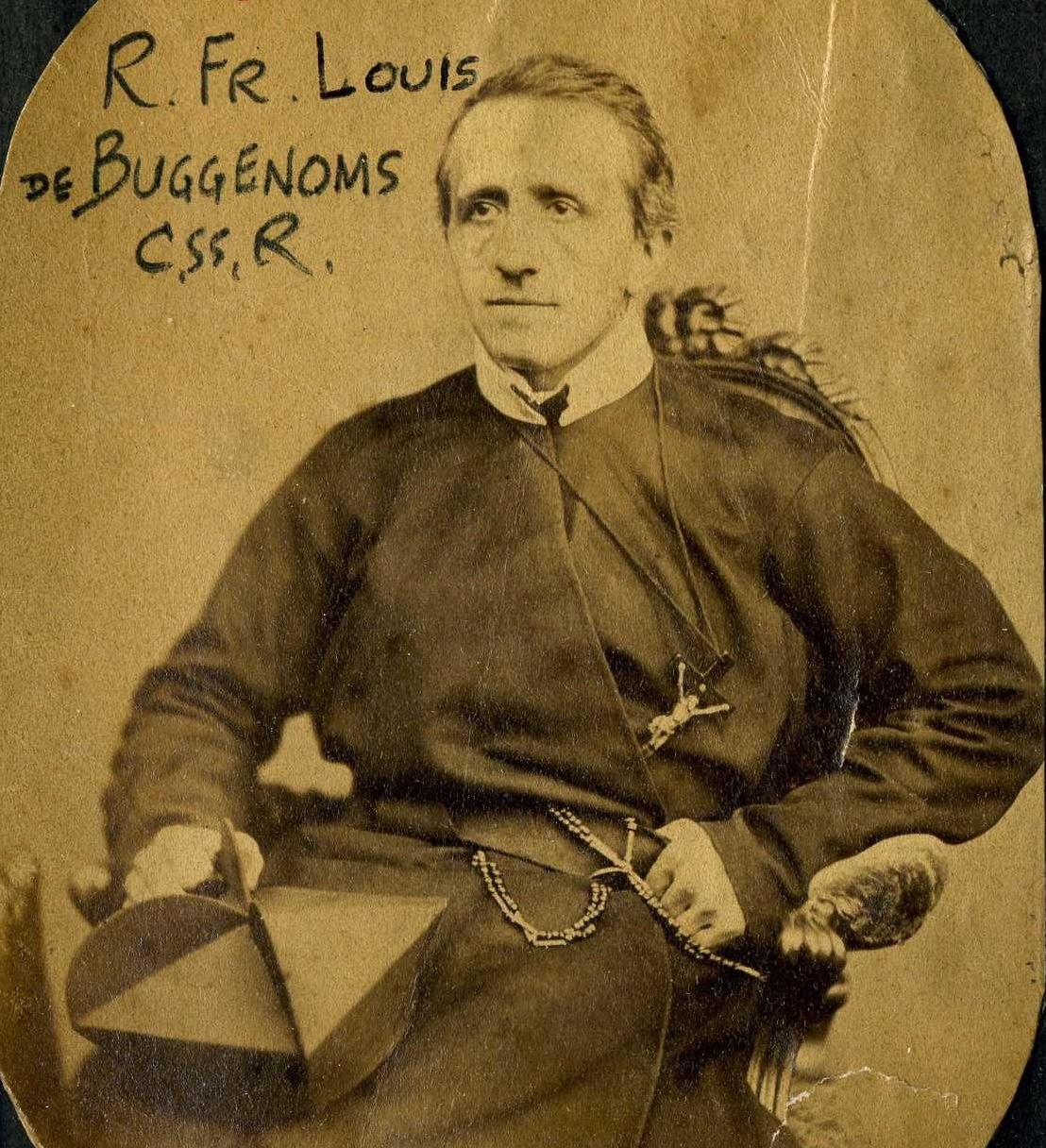
In a conversation recently with Sr Patricia Gribbin SND, the subject of Fr Louis de Buggenoms came up and she shared a number of stories that she learned when doing her own research, for her Order, the Sister of Notre Dame de Namur.
Our Fr de Buggenoms CSsR was the confreres who brought the SND to the UK - and we thank God for the amazing work they have done and currently do.
He was also the confrere who brought our Redemptoristine Nuns to Ireland.
Indeed he did great work in this Province of London and the Irish Province.
Sr Patricia SND gave this short article, written way back, to whet our whistle! Hopefully there will be more stories from our dear Sr Pat.
Enjoy!
+++ +++ +++ +++ +++ +++ +++ +++ +++ +++
FIFTY YEARS AT MOUNT ST. ALPHONSUS, LIMERICK.
1853 - 1903
REV. FATHER LOUIS DE BUGGENOMS CSsR.
We pass on to give some details of the Father who had the most important and difficult part in the foundation.
LOUIS DE BUGGENOMS was born in Liege, Belgium, on the 2nd March, 1816. He was of excellent family and had every opportunity of cultivating the more than ordinary talent with which he was endowed.
His surroundings at College were dangerous and he paints a sad picture of the morals of the youth at that time. But God had given him an extraordinary gift of faith, and this, with certain circumstances favourable to him, pre- served his soul from contamination. Indeed, if it be permitted to say so, his faith would seem to have been excessive. As a mere child he had realised, so intensely, the presence and greatness of God that, left to himself, he be- came full of fear. This state of mind had its advantages and disadvantages ; its advantages because it kept him from sin, its disadvantages since it made his spiritual nature unduly hard.
He felt the necessity of direction as he grew up, and was always desirous to serve God perfectly. “ I never,” he wrote, “had a shadow of doubt as to the truth of our Faith and the infallible teaching of the Church, for the Catechism was for me, in all truth, the pure Word of God.” The life of Our Lord, which was a great lesson for him, and the fear he had of sin made him think that the greatest blessing in this life would be to suffer martyrdom, and thence to go to heaven. This was the ruling desire of his heart. He did all in his power to prepare himself well for Communion. “ But,” he says, “ it was the preparation of the head, for my heart was contracted by fear.” It was the fear of God. He had no fear of man, and if, by chance, he found himself in the company of those who did not respect religion, or whose conduct was not good, he broke with them at once, and would never associate with them again.
He had a profound veneration for the Blessed Virgin, but even here his fear ruled him. “ I did not dare to raise my eyes to her image,” he wrote, “for I did not doubt that she was angry with me.”
Without his knowing it God was preparing him for the work He had destined for him. He came to a time in his studies when he should make choice of a profession. His father wished him to go on for the law, but the young man chose a commercial life. It was not for gain that he made the choice, but from a wish to leave Liege and settle in London, that he might serve God according to a plan which had been forming itself in his mind. This led to his perfecting himself in English. He had, about this time, formed an intimate acquaintance with a young man of unsullied morals, who had travelled much. He learned, he tells us, much from him that was useful in after years, but their friendship was soon to end. Cholera first, and then fever broke out in the city, and he saw his fellow-students dying on every side. His friend also fell ill. The Bishop of the diocese, who was much interested in him, sent a Sister of Charity to nurse him, and his own secretary to console him and give him the last Sacraments. Notwithstanding all, the patient was filled with fear towards the end. The Sister and Louis did all they could to comfort him.
The whole scene made a deep impression on De Buggenoms. The Sister of Charity, moreover, was a friend of earlier years, and the thought forced itself on his mind, “ Why should I not give myself entirely to God as she has done?” He resolved to do so; made a general confession, and began to spend two hours daily, in prayer, before the Chapel of the Blessed Sacrament in St. Martin’s Church. The only books he used were his Prayer Book, and the Visits to the Blessed Sacrament by St. Alphonsus, in which were also found Meditations on the Eternal Truths. He recited the Seven Penitential Psalms and the “Memorare” every day for the grace to know and follow faithfully his vocation.
A Priest, who was interested in him, gave him a Life of St. Alphonsus to read. “ Before I had got half-way through,” he afterwards said, “ I had made up my mind to try to become a member of his Congregation.” Providence brought about a meeting with the Venerable Father Passerat, who, after examining his vocation, promised to receive him. Father De Held, then Superior of the house at Liege, when leading him to the door, asked if he were willing to leave his own country and go, for example, to England. “That is just what I should desire,” replied the postulant. He went at once to a neighbouring church, dedicated to St. Catherine, and there, prostrate before the tabernacle, thanked Our Divine Lord for the grace of his vocation, made his plans as to how he should overcome home difficulties, and begged of God to assist him in the opposition which he expected to meet with. His success, however, in obtaining the permission of his father and mother was marvellous; and in less than ten days he was safe in the Novitiate of St. Trond.
Louis De Buggenoms received the habit on the Nativity of the Blessed Virgin Mary, 1837. The Father Rector, who preached on the occasion, compared the Novitiate to a little stream, which becomes, in time, a great river. “ Thus,” he said, “ those who are little in the Novitiate may become great and carry the Congregation into England and elsewhere.” At the end of the year St. Bede was among the annual patrons, and fell by lot to Brother De Buggenoms.
It was not difficult for the novice to see in these things, little in themselves, an opening, as it were, to his future life. He had the ordinary trials of the Novitiate, to which were added those that are proper to contemplative souls. Besides, he had to resist the entreaties, first of his father, and again of his mother, who, repenting of having consented to allow him to enter the Novitiate, sought to entice him to return once more to the world. He read the life of only one Saint, St. John Berchmans, saying that he found in it more than he could imitate. Like his saintly model he made private vows when he had been six months in the Novitiate; he made his public profession on the 8th of September, 1838.
After his profession he went to the house of studies at Liege, where he was ordained Priest, September 22nd, 1843. In those five years, sufferings, both of the interior and of the body, weighed heavily upon him; but all were, doubtless, a preparation for his apostolic life.
God allowed him to feel in himself trials, similar to those which he was destined to help others to support. The year after his ordination he set out for England with another Father and Brother Felician. It is not possible to chronicle the hundredth part of all that he did for the glory of God, and the salvation of souls in the difficult circumstances of the nine years which followed. He had a prominent part in the foundation of St. Mary’s, Clapham, and England is indebted to him for the introduction and solid establishment of the Sisters of Notre Dame, who have done much for Catholic education in that country during the last fifty years.
We have given above the events that followed from Father De Buggenoms’ arrival in Bank Place, until the laying of the first stone of the new house. In a paper written at the time, by himself, we learn that, before beginning the house, he had in hand .£5,000 ; £“3,500 of this was given by two Fathers : one was Rev. Father Douglas, who gave £1,000, and would have given more were it not for the new foundation in Rome. The other was Rev. Father William Plunkett, who gave £2,500. The rest was contributed by friends.
Father Plunkett came to Limerick on the 5th May, 1857 J and> on the next day, without informing anyone, Father De Buggenoms left for Belgium. He acknowledged, afterwards, how much it had cost him, but it was a matter of obedience and that was enough ; he had, however, only gone as far as Liverpool when a letter from the Father General appointed him to Bishop Eton.
During his stay at Bishop Eton he directed the apostolic labours of the Fathers in England, gave many missions and retreats himself, and was engaged in these works until his frail constitution gave way. One morning, immediately after rising, he had a stroke of apoplexy. By God’s permission he recovered his strength, and then undertook a work for which, we may say, God had spared his life.
Father Lans, who was Superior, had long desired to introduce the Redemptoristine Nuns into Ireland. He knew Father De Buggenoms’ talent and tact for this undertaking. No one could be better fitted for the work, for he had sent, during his stay in Limerick, some of his penitents to the Convent of Bruges in Belgium. From thence the new foundation was to be made. Interesting as the details of the preparations are, we must content ourselves with saying that he gave to Ireland in March, 1859, the first Convent of the Redemptoristines, and filled its Religious with the spirit of their founder, St. Alphonsus.
The Nuns chosen to begin the foundation were conducted from Bruges to Dublin by Father De Held. They were met in Dublin by Father De Buggenoms, and were installed in their house on Drumcondra Road in due form by the Ecclesiastical Superiors. Father De Buggenoms preached, on the occasion, a remarkable sermon on the Contemplative Life, which was afterwards published.
While in Dublin he stayed with Judge O’Brien, whose daughter was the first Irish lady to join the Community after its advent to this country. The ceremony of Enclosure took place on March 30th, and on the 8th of April, Miss O’Brien received the Habit, taking the name of Sister Mary Alphonsus. Father De Buggenoms helped the Superioress and the Community as best he could until the Feast of the Nativity of the Blessed Virgin that same year. It was the anniversary of his Profession and it brought him a letter from Father General proposing to him to set out for the Island of St. Thomas in the West Indies. He placed himself, as he had always done, entirely at the disposal of his Superior. He only asked two favours : the first, that he might make five days’ retreat, though he had already made the ten days of retreat prescribed by the rule ; the second, that he might give the Spiritual
Exercises to the Redemptoristines in Dublin. Father General gladly granted the requests; and we can easily imagine the effect of the words of this apostolic man on the Nuns, just as he was about to leave for a most dangerous and unconsoling mission.
Father De Buggenoms has been before us so much as founder, first in Falmouth, then in Clapham, and finally in Limerick, and besides in his work for the Sisters of Notre Dame and the Redemptoristines, that we may lose sight of the fact that as a preacher and director he exercised a wonderful sway over persons in every condition of life. He was Superior of some of the most successful missions, and notably the great mission in Kingstown.
Many great sinners owe their conversion to his charity, and he had a special gift of leading souls to perfection. He turned his time to such profit in the early days of his religious life that he translated into French the Life of St. Alphonsus, written in Italian by Father Tannoia. He also translated, first into French, and later into English, a little work attributed to St. Peter of Alcantara, on the Peace of the Soul: this was his own favourite book. At the request of Rev. Father Smetena, he com- piled from the German an English edition of The Mission Book.
In his notes we find many proofs that this book did much of the good work done by the missions themselves. A Protestant gentleman, who had made his studies in Oxford and was living near Limerick, bought the Mission Book, read it first through curiosity, then began to study it, and finally presented himself for reception into the Church, well instructed.
This Mission Book has been for years an heirloom in families, handed down from father to son, from mother to daughter, as a precious treasure. ,,
Father De Buggenpms also edited a new and carefully revised edition of St. Alphonsus on the Commandments and Sacraments , but this, and all his other works, passed under the humble indication : u By a Redemptorist Father.” It was his intention to bring out all the spiritual works of St. Alphonsus in popular form, and thus give effect to the desire of Sovereign Pontiffs, that they should find their way into the homes of the people, but circumstances were unfavourable. What he desired to do is now being done : already twenty-eight numbers of the Saint’s Treatises have been published.
God had, indeed, blessed Father De Buggenoms’ sixteen years of toil in England and Ireland, and this can be also said of him when the time came to cultivate other fields. Quietly, and unostentatiously, he left for St. Thomas in 1859. The remaining years, in which he was able to work, were passed in this and the adjacent islands, where the climate is always trying to the body, and the labours in which he was engaged, brought little consolation to his soul.
When almost worn out he was recalled to Belgium, and there passed the last years of his life. He died at St. Joseph’s Brussels, 23rd May, 1882, in his sixty-seventh year, praising in death, as he had done during life, the mercy of God. “ Misericordias Domini in aeternum cantabo ” are the words with which he concludes the paper from which we have taken most of what we have written in this notice of his career. R.I.P.


